Demystifying SOC 2 Compliance: A Bay Area Business Guide
If your company handles customer data, you have likely heard about SOC 2 compliance. Indeed, in the fast-moving Bay Area tech scene, getting this compliance report is not just a nice idea, it is now a basic requirement for growth. Many large companies and investors will not work with a vendor that does not have a current SOC 2 report. Therefore, this standard directly affects your company’s ability to win new clients and secure major deals.
But what exactly is SOC 2? It is not a government law, but a voluntary security standard developed by the American Institute of CPAs (AICPA). It sets out how service organizations must manage customer data securely. It ensures data privacy, availability, and security. Think of a SOC 2 report as a trusted seal of approval. It proves that you have strong, audited controls in place to protect the data you manage for your clients.
Defining Your Security Scope
The first major challenge in the SOC 2 journey is defining the scope of your audit. SOC 2 is built on five key principles, known as the Trust Services Criteria (TSC). Every audit must include the security principle, which is the foundation.You can then choose which of the remaining four criteria to include based on the services you provide and what your customers expect.
Here are the five criteria that set the security scope:
- Security (Required): This addresses protecting system resources against unauthorized access, use, or change. It includes technical defenses like firewalls and network monitoring.
- Availability: This ensures the system is operational and ready for use as promised (covering things like uptime, system performance, and quick disaster recovery).
- Processing Integrity: This ensures that data processing is complete, accurate, and authorized at all times. Consequently, this is key for financial or e-commerce services.
- Confidentiality: This involves protecting data that is designated as highly sensitive, such as intellectual property or trade secrets. Typically, it is managed through strict access controls and encryption.
- Privacy: This covers managing and protecting personal information (PII) according to your own privacy policy and legal requirements.
Most Bay Area SaaS companies must include Security, Availability, and Confidentiality in their scope because client contracts almost always require these protections. Choosing the right scope is the critical first step.
Achieving the Gold Standard Report
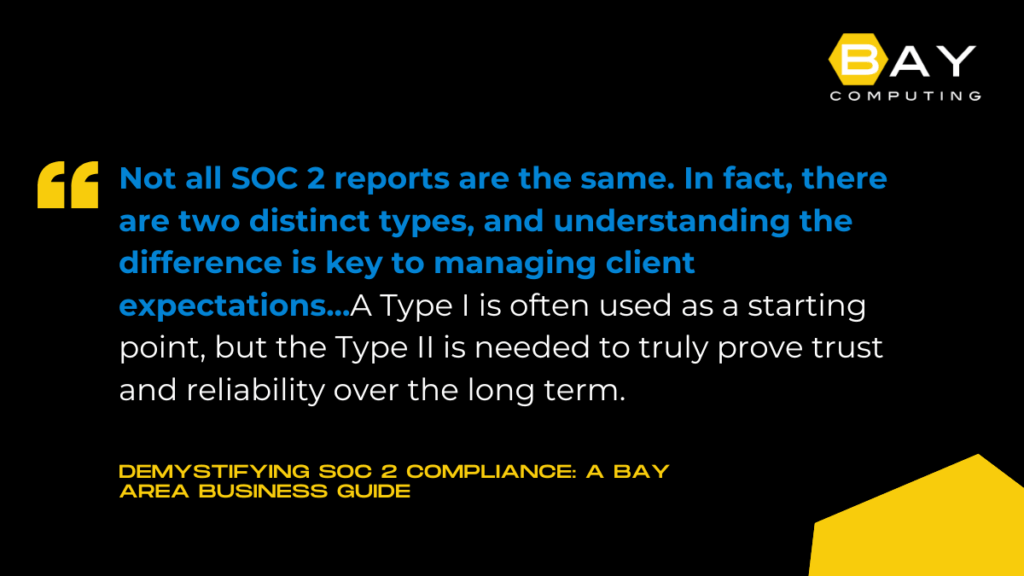
Not all SOC 2 reports are the same. In fact, there are two distinct types, and understanding the difference is key to managing client expectations:
Type I vs. Type II
The SOC 2 Type I Report is a snapshot in time. It confirms that the design of your controls is suitable to meet the Trust Services Criteria on a specific day. Essentially, it says, “We have the right policies written down.” However, the SOC 2 Type II Report is the gold standard. It confirms that the design of your controls is suitable and that the controls have been operating effectively over a period of time, typically six or twelve months. Therefore, a Type II report says, “We have been doing what we promised, and we can prove it with evidence.”
For Bay Area SOC 2 compliance, nearly all enterprise clients and investors will require a Type II report. A Type I is often used as a starting point, but the Type II is needed to truly prove trust and reliability over the long term.
Strategic Business Growth
Achieving SOC 2 Type 2 compliance is a challenging process, but the long-term strategic results far outweigh the initial effort:
- Opens the Enterprise Door: Many larger companies in the Bay Area (and nationwide) have mandatory vendor security programs. They will not sign a contract unless you can present a Type II report. Thus, compliance moves you from a risky prospect to an approved vendor.
- Builds Customer Trust: When you handle sensitive customer data, trust is everything. A SOC 2 report acts as independent proof that you take security seriously.This leads to better customer retention and a stronger reputation.
- Improves Internal Security: The process of preparing for an audit forces your team to formalize policies for access control, change management, and risk assessment. You end up with a stronger security posture that protects you from real-world threats.
- Gives a Competitive Edge: In the crowded tech market, SOC 2 compliance sets you apart from competitors. Specifically, it becomes a major selling point that can win you deals over less mature companies.
Your Path to Readiness
The compliance process is a journey, not a single event. Generally, it often requires significant preparation.
Phase 1: Preparation and Remediation
Here are the initial steps that every company seeking SOC 2 compliance should follow:
- Define Scope: Choose the necessary Trust Services Criteria based on your business model and client contracts. This ensures you only focus on what is required.
- Gap Analysis (Readiness): Work with an expert to review your current processes and identify precisely where you are missing required controls or documentation.
- Remediation: Implement new tools, write formal policies, and train your staff to close the gaps identified in the readiness assessment. This is where most of the work happens.
Phase 2: Monitoring and Final Audit
- Monitor and Collect Evidence: For a Type II report, you must run the new controls for the entire audit period (at least six months) and collect evidence of their operation.This evidence collection is what the auditor checks.
- External Audit by a CPA: Hire an independent CPA firm to perform the official examination. They review the evidence and issue the authoritative SOC 2 report.
Remember: SOC 2 is a continuous process. Once you get the report, you must maintain those controls and undergo an annual audit to stay compliant.
Final Thoughts
Don’t let compliance drain your resources. For Bay Area tech leaders, achieving the gold standard is essential, but it doesn’t have to be a full-time distraction. Bay Computing specializes in making SOC 2 Type II compliance an achievable reality. We partner with you to transform complex mandates into a secure, functional cloud architecture. Our strategic consulting and deployment services cover the US, including major tech hubs like the Bay Area, as well as our core service areas of Massachusetts and Boston. We provide end-to-end support through our proven managed cloud services. Stop sacrificing focus on product development. Contact us today, and let’s turn your necessary security requirement into a smooth, competitive asset.