Navigating the 2026 CCPA Audit Rule: Is Your SMB Prepared for Mandatory Certification?
In the world of business, there is a recurring villain that doesn’t wear a cape or monologue about world domination. Instead, it shows up as a quiet update to a regulatory framework. For years, the California Consumer Privacy Act (CCPA) was viewed as a big tech problem, much like a dragon for the Googles and Metas of the world to slay. But as of 2026, the stakes have shifted. The dragon has moved into the neighborhood, and it’s asking to see your paperwork.
The new 2026 CCPA Audit Rule isn’t just another suggestion for your privacy policy. It introduces a mandatory cybersecurity audit and an annual executive certification. If your business processes significant amounts of personal information or hits specific revenue milestones, you are now legally required to prove your defenses are up to snuff. The challenge is that many SMB leaders are still operating on outdated maps, unaware that the territory has changed beneath their feet.
Myth #1: We Have Until 2030 to Worry
The biggest trap for SMBs is misinterpreting the staggered phase-in dates. While the first certification for businesses under $50 million in revenue is due April 1, 2030, the audit period actually starts much sooner. To certify your compliance, you must prove you had controls in place during the preceding year. If you wait until the deadline year to build your security program, you’ve already failed the audit for the previous 12 months.

Taking the First Step
The first step isn’t a massive overhaul; it’s a simple assessment of where you stand today. By identifying your data footprint now, you avoid the panic of a last-minute scramble. Don’t let a regulatory update be the thing that slows your momentum. Mapping out which consumers fall under the “significant risk” category is the most logical starting point to determine how the California Privacy Protection Agency (CPPA) will view your specific operations.
Myth #2: My Internal IT Team Can Sign Off
One of the most misunderstood parts of the 2026 rule is the requirement for an independent auditor. This is a deliberate choice to prevent mark-your-own-homework syndrome. Even if you have a stellar internal team, the law requires an objective set of eyes to verify the work. This ensures that the executive signing the certification, under penalty of perjury, is protected by a layer of professional verification.
Does This Rule Apply to You?
You might be thinking, I’m not in Silicon Valley, so I’m safe. Not quite. The CCPA has a long reach, affecting any business that does a certain volume of business with California residents. The 2026 Audit Rule zeroes in on significant risk activities. If you process sensitive information for 50,000+ consumers or have crossed the inflation-adjusted revenue threshold (now roughly $26.6 million), the clock is ticking.
The Shift from Compliance to Accountability
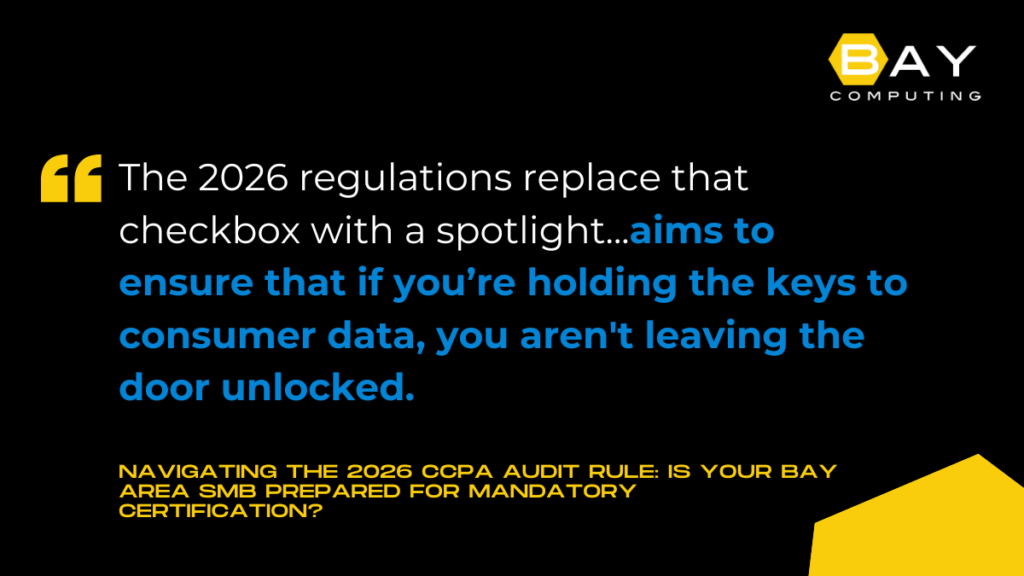
For a long time, compliance was a checkbox. You hired a consultant, updated a page on your website, and went back to work. The 2026 regulations replace that checkbox with a spotlight. The state is responding to a reality where SMBs are often the weakest link in the data supply chain. By mandating these audits, the CCPA aims to ensure that if you’re holding the keys to consumer data, you aren’t leaving the door unlocked.
The Hidden Cost of Wait and See
The most dangerous thing an SMB can do right now is wait for an enforcement notice. The audit process isn’t something you can finish over a weekend. You need to prove you are using phishing-resistant multi-factor authentication and that your data is encrypted both at rest and in transit. If you scramble at the last minute, you aren’t just paying for an audit; you’re paying a chaos tax of emergency fixes and potential fines.
Modern Security is an Asset, Not a Bill
It’s easy to view these audits as a grudge purchase or money spent just to stay out of trouble. But there is a different way to look at it. In a market where trust is a disappearing commodity, being able to prove your security posture is a competitive advantage. When you can tell your clients, We are CCPA certified, you aren’t just compliant; you’re the safest choice in the room.

Turning the Audit into a Roadmap
The audit shouldn’t be a pass/fail exam; it should be a diagnostic tool. A proper independent auditor will show you exactly where your gaps are. Maybe your password policies are from 2015, or perhaps you’re storing data from former customers that you should have deleted years ago. These aren’t just compliance issues, but rather, they are business risks that could lead to a total system collapse.
Bringing it Home to the Bay and Beyond
Whether you are managing a growing firm in the San Francisco Bay Area or steering a tech-focused business in Boston, the geography of your office matters less than the geography of your data. The 2026 CCPA Audit Rule is a federal-level headache packaged in a state-level law, and it’s hitting Massachusetts businesses just as hard as those in California.
At Bay Computing, we’ve seen how these shifts can paralyze a team. We believe technology should be the engine of your growth, not an anchor of anxiety. Our Complete Care approach is designed to take the mystery out of compliance. We help you build the foundation so that when the audit season arrives, you aren’t looking for a place to hide—you’re looking for a pen to sign your certification. If you’re ready to clear the hurdles of managed IT and security, we’re here to help you cross the finish line.