Practical Uses of Generative AI in IT Operations
The problem in modern business isn’t usually a competitor or a market shift: it’s the friction of daily operations. For many IT managers and business owners, technology can feel like a runaway train. You’re dealing with more data, more security threats, and more user requests than ever before, all while trying to keep the lights on. It’s exhausting to feel like you’re constantly playing catch-up with your own infrastructure.
But there is a shift happening. Generative AI is moving past the fun toy stage and becoming a practical tool for streamlining the heavy lifting of IT. This isn’t about replacing the human element; it’s about removing the repetitive, soul-crushing tasks that keep your best people from doing high-value work. When used correctly, GenAI acts as a force multiplier for your existing operations.
Streamlining the Help Desk Chaos
Most IT teams spend too much time on basic support. They reset passwords and fix Wi-Fi issues all day. Generative AI changes this by using smart tools to solve technical problems. Instead of a boring FAQ page, users get answers through a simple conversation. These tools understand what a user needs and give clear help in real-time.

The Transformation of Support:
- From Lag to Lightning: Stop making users wait hours in a ticket queue. Gen AI provides instant, 24/7 conversational assistance, ensuring the IT department isn’t a bottleneck for company productivity.
- From Manual to Automated: Instead of senior engineers typing out the same instructions for the thousandth time, AI instantly pulls from verified knowledge bases, delivering precise answers in seconds.
- From Boredom to Brilliance: Free the staff from death by a thousand password resets. By automating the mundane, the team can finally pivot to high-value problem solving and strategic growth projects.
This shift preserves the cognitive energy of the staff. When a team isn’t bogged down by the same five questions every day, they can focus on proactive projects like improving network performance or long-term strategic planning. It turns the help desk from a bottleneck into a streamlined gateway.
Predictive Maintenance and Incident Response
One of the most practical uses of GenAI in IT operations is its ability to synthesize vast amounts of log data to identify patterns humans might miss. Instead of waiting for a server to crash or a network link to fail, AI models can flag anomalies that signal an impending issue. This moves from reactive to predictive, allowing the team to fix the problem before the rest of the company even knows there was one.
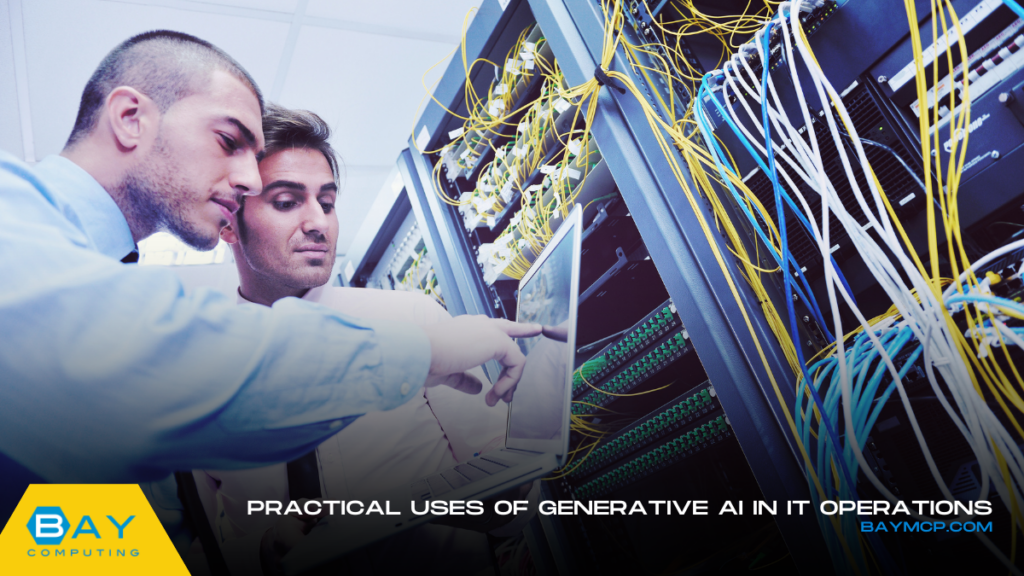
During an active incident, GenAI can act as an automated scribe and analyst. It can summarize the last hour of technical logs into a concise briefing for stakeholders or suggest remediation steps based on how similar incidents were resolved in the past. It’s like having a senior architect looking over your shoulder, offering context when things get heated.
Automating the Boring Stuff: Documentation and Scripting
If you ask any IT professional what they hate most, documentation is usually in the top three. Yet, clear documentation is the backbone of IT service management. Generative AI excels at taking a rough set of technical notes or a recorded meeting and turning it into a structured, readable knowledge base article. It ensures that tribal knowledge is captured without requiring hours of manual typing.
AI also helps with coding. It can write the base code for new scripts in seconds. Whether you need to onboard a user or audit permissions, GenAI handles the draft. You still need to check the work. However, your team will spend time auditing and refining code instead of starting from scratch. It makes every developer faster and more accurate.
Strengthening the Human-AI Partnership
The goal is simple. Technology should support your business goals without becoming a burden. New research from Gartner shows that AI automation will soon cut costs. It will also help companies grow much faster. The key is to start with small, high-impact tasks that give your team immediate relief.
Pro Tip for IT Leaders: Don’t start with a wide General AI rollout. Identify where the team is already using unapproved AI to write scripts. Centralizing these efforts ensures that company data stays within the secure perimeter.
It is also vital to consider the security implications of these tools. As noted by NIST, implementing AI requires a framework of trust and transparency. You want to ensure that the data you feed into these models stays private and that the outputs are consistently validated by human experts.
Scaling Without Adding Stress
Businesses across the United States face a common challenge. They need to grow without breaking their budget. Generative AI allows you to expand your capabilities while keeping your core team lean. It gives a small IT department the same power as a massive enterprise. Your staff can handle a higher volume of work without the burnout often caused by rapid growth.
In fast-paced areas like Boston, efficiency is a massive competitive edge. When IT operations run smoothly, your team can focus on the innovations that truly help your customers. You stop spending your day fighting fires. Instead, you start building a scalable foundation that supports the long-term health of your company.
Navigating the Future with Bay Computing
At Bay Computing, technology is a bridge to your goals, not a barrier. We help you choose the right tools to solve real business problems. This is not about chasing every new trend. It is about strategic oversight. We ensure your systems are stable and your workflow is ready for what comes next.
From our home in Greater Boston to partners across the country, we guide firms through the shifting IT landscape. Stop reacting to tech issues. Start using tools like Generative AI in IT operations in Massachusetts to lead your market. Visit our Managed IT Services page to see how we can build a more resilient future together.